Recipes & Lore • Bakery Counter Canon
Pizza Strips, a.k.a. Party Pizza
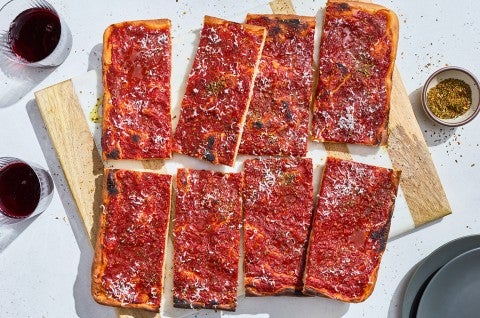
Out-of-staters see a tray of pizza strips and diagnose three mistakes: it's cold, it's cheeseless, and it's cut into rectangles. Rhode Islanders see a funeral, a graduation, a christening, and every birthday party they've ever attended. Pizza strips — also answering to bakery pizza, party pizza, red strips, and red bread — are a thick, focaccia-style crust under a concentrated, garlicky tomato sauce, sold by the tray at Italian bakeries and served at room temperature, on purpose, always.
Why there's no cheese (a real answer)
The strip descends from the focaccia that Italian immigrants brought to Providence's Federal Hill in the early 1900s — by 1920, Italians were the state's largest foreign-born community, and its bread bakeries were neighborhood institutions. Early versions had cheese, like the Neapolitan pies of New York and New Haven. The bakeries dropped it for a beautifully practical reason: no cheese meant no refrigeration — trays could sit at room temperature all day, and a millworker's lunch stayed good until lunch. The constraint became the identity. The sauce, thick and garlic-forward, concentrates and sweetens in the oven and does all the work the cheese isn't there to do.
Pizza chips: the round ones (yes, the Real Housewives thing)
Same dough, same sauce, cut small and round instead of into rectangles: that's a pizza chip, the strip's beach-going cousin, sometimes finished with a light dusting of Parmesan or Romano. If the name sounds familiar, it's because The Real Housewives of Rhode Island recently put them on national television — cast member Alicia Carmody handed them around at a North Kingstown beach while a castmate from away asked where the cheese was. Her defense, as the Boston Globe reported, was the entire history of the dish in one line: it's lighter, you bring it to the beach, and "you don't have to deal with cheese in the sun." A century after the bakeries dropped the cheese so trays could sit out all day, that is still exactly the point. To make chips at home, roll the same dough a little thinner, cut rounds, sauce, and bake until the edges crisp — everything else below applies unchanged.
You need
- 4 cups bread flour
- 2 tsp instant yeast, 2 tsp salt
- 1¾ cups warm water
- 3 tbsp olive oil + more for the pan
- 1 can (28 oz) crushed tomatoes + 2 tbsp tomato paste
- 3 cloves garlic, minced
- 1 tsp dried oregano, ½ tsp sugar, ½ tsp salt
Method
- Make a soft dough (flour, yeast, salt, water, oil); knead briefly; rise ~1½ hours until doubled.
- Simmer the sauce ingredients ~20 minutes until genuinely thick. A watery sauce makes a soggy strip; the sauce is the whole show, so reduce it like you mean it.
- Press the dough into a well-oiled half-sheet pan, dimpling like focaccia. Rest 30 minutes.
- Sauce edge to edge. No cheese. This is the identity of the dish, not an omission.
- Bake at 450°F, 20–25 minutes, until golden underneath and jammy on top.
- Cool completely, cut into rectangles, serve at room temperature. Reheating a pizza strip is a confession that you're from away.
Sources & further reading
- Red Sauce America — The History of Rhode Island's Pizza Strips
- Saveur — Rhode Island Pizza Strips Are Not Your Average Slice
- King Arthur Baking — Rhode Island Pizza Strip Recipe
- PMQ Pizza — The Rhode Island Red Strip
- Parade — Rhode Island Pizza Strips: History & How To Make
- The Boston Globe — No One in Mass. Has Heard of the Snack That Rhode Islanders (and Real Housewives) Are Obsessed With
Send the rest of the party
Fresh bakery trays don't ship — but the shelf-stable Rhode Island canon does, packed in our gift boxes with the field guide that explains all of this to the uninitiated.
Shop the Boxes